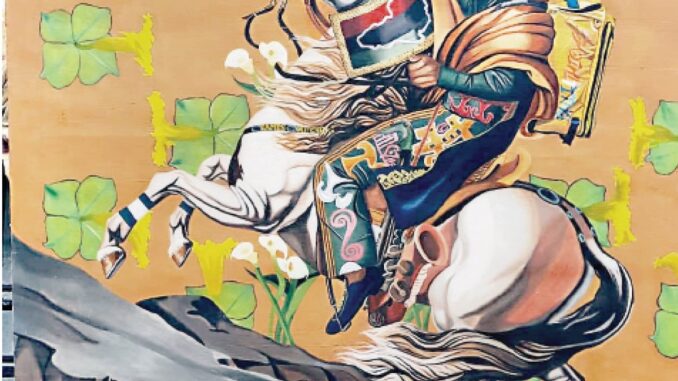
A painting made during the 2020 #EndSARS protests, honouring Afrobeat creator Fela Anikulapo Kuti, as the emperor of music, who shaped an artist’s understanding of courage, is missing.
IN October 2020, while #EndSARS roiled Lagos, artist Mitchelle James Innocent chose a different path. Rather than march, he protested through his art, turning his studio into a space for creative resistance.
Fela, the creator of Afrobeat and a protest musician, inspired ‘Passion for All; Fela’s Call’ (2020). This oil painting shows Fela on horseback as the ‘Emperor of Music’.
Even though Mitchelle put great care and intention into the painting, it has disappeared. Now, his tribute is linked to a mystery that overshadows his artistic journey.
The painting draws inspiration from Jacques-Louis David’s 1805 portrait of Napoleon Crossing the Alps, capturing the grandeur of European imperial art. In David’s work, Napoleon appears heroic and untouchable, caught in a moment where history seems to follow his lead.
Mitchelle uses the same style but changes its meaning. Instead of Napoleon, Fela sits on the horse. He carries no sword or armour, just an orange saxophone. Here, sound takes the place of violence, and rhythm stands in for command. The struggle is against injustice, not for land. Under the horse’s hooves, words are carved into imagined rock: “Fela Kuti”, “Bonaparte”, “Kwarantine”, and “Palliathieves”. These mixed timelines and symbols blend empire with rebellion and history with satire. Where power once came from force, it now shows up in lyrics and music.
The words “Kwarantine” and “Palliathieves” add a clever touch, suggesting the kind of lyrics Fela might have written about the politics of COVID-19.
But the painting is more than just an intellectual statement. For the artist, its creation is deeply personal, giving it extra meaning. Mitchelle was born four days after Fela, and they share the same birth month. He sees this timing as symbolically important.
READ ALSO: Fela Anikulapo Kuti: What it means to be a legend
“Sharing a birth month with Fela made this tribute personal,” he says. “Our timelines echo each other. His fire shaped how I view art as a weapon.”
He created the painting as a birthday tribute to Fela after his passing, linking himself to his artistic ancestor. Made during the #EndSARS protests, the work captures youthful energy, the influence of digital culture, and a strong desire to remember.
Fela’s life was full of confrontation. He defended human rights, spoke out against bad leadership, and refused to be silenced. In 2020, his legacy felt less like history repeating itself and more like a chorus that keeps going.
In ‘Passion for All; Fela’s Call’, the horse looks tense, showing a nation reaching upward, caught between resisting and changing. The background is filled with Nigeria’s yellow trumpet flowers, and the horse is decorated with green-white-green colours along with Pan-African shades.
Before it disappeared, the painting was shown at the New Afrika Shrine during Felabration 2024, and later at Art Hotel Lagos. Its rich symbolism and sense of urgency caught people’s attention.
At its last showing in 2024, the painting was valued at ₦500,000. But its real value is more than its price. The painting stands at the crossroads of classical art, Afrobeat ideas, pandemic commentary, and protest culture.
In January 2025, after the artist relocated from Lagos, part of his collection, including ‘Passion for All; Fela’s Call’ remained behind in a Satellite Town studio. Over the next several months, the space was accessed intermittently for exhibition logistics and international shipments. By August 2025, the remaining works had been catalogued and dispatched.
However, one piece, ‘Passion for All; Fela’s Call’, did not leave Lagos with the rest of the collection. By October 2025, the absence of ‘Passion for All; Fela’s Call’ was undeniable. After attempts at finding it proved unsuccessful, the case was formally reported to the nearest police station in Satellite Town, Lagos State.
Still, losing the painting means more than just a missing item on a list. When a protest artwork disappears, the loss is more than just physical. What else is lost with it? Is it a moment, a memory, or a history of resistance? The disappearance leaves an open question.
For the artist, the loss is deeply felt: “This wasn’t just a painting. It was created in protest, honouring the Emperor of Music who shaped my understanding of courage. Losing it feels like losing a part of my creative identity.”
In response, Mitchelle asks collectors, curators, galleries, and the public to watch for the artwork. He says finding it would help bring back a voice that will not be silenced.
WATCH TOP VIDEOS FROM NIGERIAN TRIBUNE TV
Leave a Reply