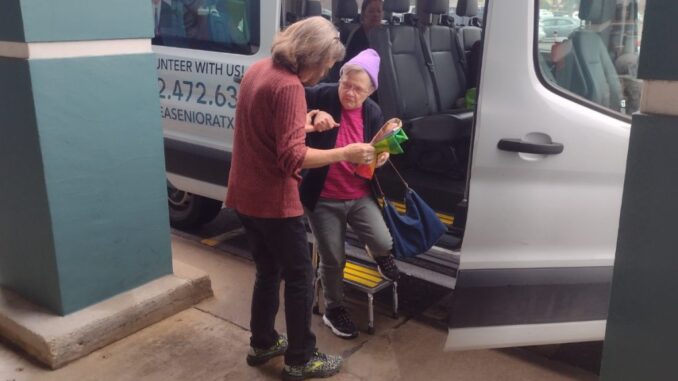
Teddy Ellis rolled up to the parking lot of a kolache shop around 9 a.m., wheeling her bulky nine-seater van into a semi-parked position before rolling down a window to greet her first pickup of the day.
Ellis volunteers for Drive a Senior, a nonprofit that organizes free, on-demand rides and other services for Central Texans over 65. Today she was operating one of her regular routes, a grocery run, which she does three times a week.
She got underway to gather the rest of the morning’s passengers: 88-year-old Veda, 94-year-old Jim, 78-year-old Paula, and 66-year-old Barb. Then she drove to the nearest H-E-B.
Ellis has been making runs like this for Austin seniors for eight years now. She recalls that when she began, she was asked if she could just stay on until they hired somebody. “Then that went on for a year or two,” Ellis said, “and now they say it as a joke.”

Image credit: Miles Wall.
Aging paradox
The national story about Austin is that it’s a city of young tech workers, and the “young” part of that remains true. The median age of an Austinite is around 34.8. But in a statistical twist, the city is also aging rapidly.
As of 2023, adults over 65 were the fastest-growing group in the city. While today seniors represent only around 10 percent of Austin’s population, that figure is expected to jump to 22 percent by 2060.
As they age, many seniors will face unique transportation challenges. Faltering eyesight, mobility issues, and age-related cognitive decline can make it dangerous or impossible to drive. In a state like Texas, where 90 percent of trips are by car, that can make it difficult to get around.
Mission-driven merger

Drive a Senior was created to help address those problems. It began in 1985 as West Austin Caregivers before changing its name to Drive a Senior West. In 2020 it merged with Drive a Senior North Central to form Drive a Senior-ATX. A further consolidation came last August when Drive a Senior-ATX joined with two other nonprofits that Drive a Senior executive director Jill Skinner describes as “mission-aligned.”
One of those nonprofits was Chariot, which served seniors south and west of the Colorado River as far as Dripping Springs and Bee Cave, and the other was Senior Access, which covered areas north and east as far as Georgetown and Manor. When the groups joined forces they kept the Drive A Senior name but dropped the ATX to reflect their broader turf.
Skinner said the merger was the culmination of more than a year of talks between the organizations, which all have deep roots in Central Texas.
“It’s now a huge territory,” Skinner said. “So, we’re just trying to, y’know, spread the love.”
Drive a Senior does about 400 rides a week, said Drive a Senior Volunteer Coordinator Deborah Nieves, for a total of roughly 20,000 rides a year. Since one-fifth of those rides are group rides like the one Ellis drives, the number of individual boardings is higher.

Image credit: Miles Wall
Driving out isolation
Besides rides, Drive a Senior also makes “friendly calls,” where volunteers phone up seniors who may be suffering from isolation or just need someone to talk to. Volunteers made more than 1,000 such calls in 2024.
Skinner understands isolation problems. Prior to joining Drive A Senior in 2023, she worked for the Make-a-Wish foundation. At that time, her elderly mother began to need rides to and from appointments. Often, Skinner said, where her mother wanted to go had more to do with making connections and avoiding boredom than getting something done.
“She’d call me crying, ‘Can you do something tonight? I feel lonely, I want to get out of the house,’ those kinds of things,” she said. “I really think that when it comes to the point where you can no longer provide yourself transportation, that’s what kicks it off. And it’s a hard thing. I’ve seen it.”
Embracing tech

Deborah Nieves said that one of the organization’s biggest challenges is recruiting volunteers. That has been brought into starker clarity since the merger with Chariot and Senior Access.
“That’s when we realized how much the other agencies were hurting, because they hadn’t had a volunteer coordinator in place for years,” she said.
In the past, volunteers have often come through word-of-mouth from church congregations and volunteers’ social circles. Nieves said she’s trying to improve that pipeline by having tables at events and getting partners to promote volunteering opportunities.
Lately, some have been referred from an unlikely source: AI.
Over the last year, Nieves said, a few volunteers discovered Drive a Senior by asking questions of Google or ChatGPT. “That’s really good and reassuring that we’re moving with the technology.”
A lack of volunteers makes it hard to find drivers for doctor’s visits or dialysis sessions. To close that gap, Skinner said that Drive a Senior’s precursor groups spent roughly $115,000 on Uber and Lyft rideshare services last year.
“When people know (Drive a Senior) as a volunteer-driven organization – pun intended – they may not think that we need funds to keep the agency running,” she said.
The bus route
CapMetro likely transports more seniors than any other single organization in the Austin area. While not broken down by age, the agency’s annual ridership statistics track 24 million bus boardings, 1.2 million on-demand trips, and more than 600,000 rail trips. If just 1 percent of those boardings were seniors, that would exceed 250,000 rides last year.

Image credit: Miles Wall.
The CapMetro bus isn’t always a good choice. Jim Moehler, 94, legally blind and unable to drive, said he doesn’t consider riding the bus because he doesn’t know where he would go to catch one, and he doesn’t relish the idea of walking to a bus stop. He also likes Drive a Senior’s convenience and familiarity.
“I get a driver that, probably, knows me, knows where I’m going,” Moehler said. “There’s too many unknowns with those other services.”
Moehler isn’t alone. A 2013 city report found that 67 percent of Austinites felt they “don’t have good options” if they couldn’t drive themselves. Another 63 percent said they could not rely on low-price, on-demand transit services.
Access, CapMetro’s only citywide on-demand service, has a long waitlist and is reserved for people with specific disabilities. Not being able to drive isn’t necessarily enough to qualify.
Amelia Robinson, a resource director for AGE of Central Texas, consults with seniors and caregivers. She said she rarely recommends Access to seniors who need a ride quickly due to the delays involved in getting signed up and booking a ride.
“Very often an older adult might have had a friend to take them to an appointment, but something got moved around and now they only have two days to obtain a ride,” Robinson said. “Time is a big, determining factor.”
She said she favors GoGoGrandparent, a site that provides rideshares and other services tailored for seniors, for urgent transit needs — followed by Drive a Senior.
“Services such as paratransit and on-demand microtransit are designed to address individual mobility needs, yet gaps remain across much of the region,” CapMetro said in a written statement. “As more older adults age in place, demand for reliable, accessible transportation continues to grow, often outpacing what any single agency can provide on its own.”
Who’s driving whom?
It was almost four hours before Ellis dropped off her last passenger and started wending her way back home. She has provided such rides multiple times a week for years. But Ellis doesn’t see it as a chore.
“I’m blessed,” Ellis said when asked what keeps her volunteering with the organization. “I love it. I assume it’s got to be somebody who really wants to help, but once they meet these people they’re gonna stay.”
Miles Wall is a freelance journalist living in Austin, Texas. He relocated to Texas from Philadelphia, Pennsylvania, where he earned a bachelor’s degree in Journalism from Temple University. Since moving to Austin, he has written for The Austin Monitor and worked to build a beat in development and transportation.
Leave a Reply