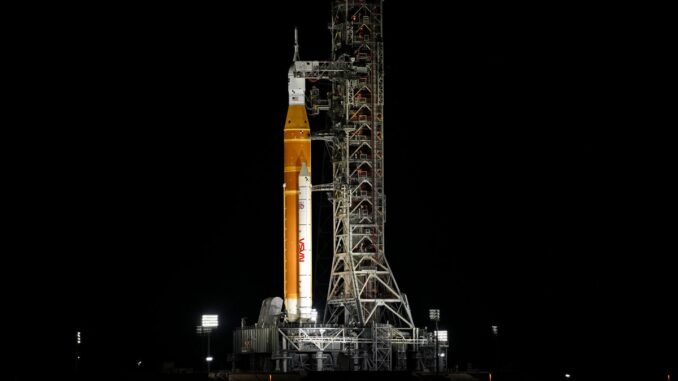
NASA fueled up its giant lunar rocket and completed a launch-day walkthrough on Thursday ahead of its highly anticipated mission to send four astronauts around the moon.
The hourslong test, known as a “wet dress rehearsal,” was an essential step before NASA is expected to set a targeted launch date for the mission, known as Artemis II. The crew could lift off as soon as March 6 — starting a 10-day journey during which they will orbit Earth then make a figure eight around the moon.
The Artemis II mission will be the first time humans travel to the moon in more than 50 years, and the crew is expected to reach a greater distance from Earth than anyone has before. The flight will also mark the first time that NASA’s Space Launch System rocket and Orion capsule carry people.
The results of Thursday’s rehearsal at NASA’s Kennedy Space Center in Florida will help mission managers assess recent repairs made to the rocket, after they found a hydrogen leak during the first wet dress rehearsal last month. The leak forced NASA to stop that Feb. 2 test early and forgo all launch opportunities this month.
During Thursday’s fueling test, which ended around 10:16 p.m. ET, engineers had the chance to study the effectiveness of the repairs in real-world conditions. NASA officials will now comb through the results and weigh the overall readiness of the rocket and its various systems. The space agency is planning to discuss the findings of the second wet dress rehearsal in a news briefing on Friday at 11 a.m. ET.
If all went smoothly, the agency has said it has launch opportunities from March 6 through 9, and again on March 11.
The wet dress rehearsal formally began on Tuesday evening and continued through Wednesday, as teams powered up parts of the rocket and spacecraft and charged flight batteries. The main part of the test, however, started Thursday morning, after mission managers gave the go-ahead to fuel the Space Launch System rocket.
At around 10:30 a.m. ET, liquid hydrogen and liquid oxygen began flowing into the rocket’s core stage. In total, the booster was filled with more than 700,000 gallons of cryogenic propellant, and mission managers practiced counting down to a simulated launch time of 8:42 p.m. ET.
The fueling test appeared to proceed without any major issues. NASA was able to conduct two walkthroughs of the final 10 minutes of the countdown, with a pause at roughly T-minus 1 minute and 30 seconds. At around T-minus 33 seconds, NASA reset the clock back to T-minus 10 minutes and ran through the final moments before liftoff once again.
These stops and starts were designed to demonstrate that the rocket’s systems were performing as expected during the final part of the countdown, when automated systems take over control of the booster. The pauses and resets also gave mission managers a chance to practice different scenarios, such as situations in which issues crop up that need investigation or in which a launch has to be called off due to technical issues or bad weather.
NASA announced Thursday that the next Artemis mission, which will send four astronauts on a flight around the moon, will be delayed until 2026.
The four Artemis II crew members — NASA astronauts Reid Wiseman, Christina Koch and Victor Glover, and Canadian astronaut Jeremy Hansen — did not participate in the wet dress rehearsal, though NASA still practiced closing the Orion spacecraft’s hatches.
After NASA discovered leaking hydrogen fuel at the tail end of the rocket during the prior rehearsal, the agency replaced two seals on fueling lines and conducted a partial fueling test to assess the repairs. That test, in turn, turned up other issues with ground support equipment, which appeared to reduce the flow of liquid hydrogen into the booster. NASA said earlier this week that it had replaced a filter in the affected equipment.
The Artemis II astronauts are expected to enter quarantine in Houston for around two weeks before their launch. That could be as early as Friday if the rehearsal went well, though NASA has said it “will not set a formal launch date until after a successful rehearsal and data reviews.”
Artemis II is a key step for NASA as it works to return astronauts to the lunar surface. Just like it did during the Apollo program of the 1960s and ’70s, NASA is testing its systems with a trip around the moon before it attempts to land astronauts on the lunar surface — that milestone is planned for the Artemis III mission in 2028.
The upcoming flight follows the uncrewed Artemis I mission in 2022, when NASA sent the SLS rocket and Orion capsule on a trip around the moon without any people onboard.
During the first wet dress rehearsal for that earlier flight, NASA identified hydrogen leaks that wound up delaying the mission six months.
Leave a Reply