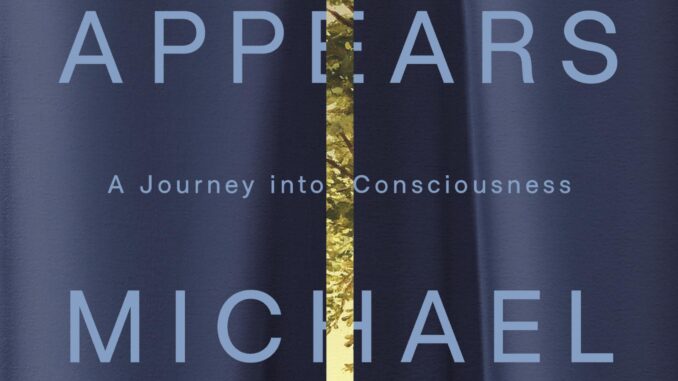
It was the plume poppies in Michael Pollan’s garden that seeded his new book. On a warm September afternoon, he was tripping on shrooms when the spindly, whimsical flowers appeared to be returning his gaze as they happily bathed in sunlight.

On the Shelf
A World Appears: A Journey into Consciousness
By Michael Pollan
Penguin Press: 320 pages, $32
If you buy books linked on our site, The Times may earn a commission from Bookshop.org, whose fees support independent bookstores.
“I came out of that, thinking: What do you do with that, with an insight on psychedelics? I mean, do you just dismiss it as fantasy or do you accept it as true?” he says, reflecting on the experience from his couch on a winter day in Berkeley.
The experience sent Pollan on a journey to understand consciousness (what it is, who has it and the moral implications) — alongside other age-old queries, such as how we know anything at all. From this inquiry comes his tenth book, “A World Appears,” released this week.
Like all of Pollan’s books, in his latest work, the reader goes on a voyage of discovery with him as he interviews leading scientists and looks to literature, Indigenous epistemologies, psychology and even plants themselves for answers to questions that may not have answers. Along the way, he realizes that the ethical significance of his investigation is much greater than he first imagined.
What consciousness is (and who has it), he writes, should at least give us pause as we consider how governments and corporations extract resources from arguably sentient ecosystems. He examines how careful we need to be as we develop AIs that may hold the capacity for their own suffering, whether we should be selling our own awareness to social media platforms in exchange for entertainment, how we treat animals and much more.
“This interiority we have is so precious,” says Pollan, as he leans back against his cushy brown sofa in a navy blue sweater and worn loafers, a cup of green tea at his side. In every moment, he points out, even now, “we’re having a conversation, but you also have a conversation going on in your own head at the same time. It’s crazy.”
This “private space of freedom,” he says, “we’re giving away and is being bought and sold by companies. We talk about the hacking of attention, but what is attention, if not, this very important aspect of consciousness, right? And now we’re moving into this further giveaway realm with chatbots with which people are forming these emotional attachments. And so now they’re hacking something deeper than attention, which is our emotion and our ability to attach to other human beings. And so there’s an implicit argument in the book that we need to be more conscious and not give it away, protect it. Defend it.”
But what is “it”? One of the biggest quandaries when investigating the nature of consciousness is that no one can seem to even agree on what it is. Is it self-awareness — the ability to recognize oneself as a distinct entity moving through time? Is it intelligence, or the capacity for language? Is it the ability to feel pain? To experience pleasure? Or is it something more elusive: the felt quality of being, the fact that there is something it is like to be you at all?
These questions are integral to defining who has consciousness — and what that means for how we treat those beings. If consciousness requires sophisticated self-reflection, then perhaps only adult humans qualify. If it requires only the capacity for subjective experience, then many animals almost certainly do. If it emerges from certain kinds of information processing, then advanced AI systems might someday meet the criteria. These questions also have implications for debates around when it’s ethical to terminate a pregnancy or the life of a person who is seemingly nonresponsive.
Generally, in philosophy of mind, consciousness is defined in the broadest sense as subjective experience — the presence of a first-person point of view. Not intelligence, not behavior, not responsiveness, but the existence of an inner life: sensations, feelings, perceptions, thoughts — however minimal — that are experienced by someone.

Michael Pollan, author of “The Omnivore’s Dilemma,” “In Defense of Food,” “How to Change Your Mind” and more.
(Carolyn Fong / For The Times)
Much of the first part of the book, Pollan turns to materialist researchers using the scientific method to try to identify consciousness in the brain and body, a pursuit that academic institutions only came to see as legitimate in the ’90s. Before that, consciousness studies was relegated to the humanities — philosophers, writers, artists. Pollan traces this divide back to Galileo, who popularized the idea that science should concern itself with what can be measured and mathematically described. The mind (or “the soul,” as it was understood at that time) — including our subjective experiences — was considered too slippery to study. In retrospect, Pollan says, this siphoned hugely essential parts of who we are off from scientific investigation — and established a field which, to this day, doesn’t have methodologies for understanding anything that may exist beyond the material realm.
For this reason, consciousness studies, Pollan provocatively suggests, may prompt the first scientific revolution in nearly 500 years. He points to the ayahuasqueros, or shamans of the Amazon Basin, as an example of how humans have engaged in radically different methodologies of discovery for generations. “When asked about the source of their astonishing ethnobotanical knowledge (including the not-at-all-obvious recipe for combining two plant species to make ayahuasca), [they will tell you] that the plants, through dreams and visions, teach them what to do,” he writes in “A World Appears.” “Our culture formed and bound by empirical science, will never credit such an explanation. But what if there is some important sense in which it is true?”
Christof Koch, a leading consciousness researcher and primary source in Pollan’s book, began his career as a strict materialist, believing everything could be explained using the standard scientific worldview. “I’m much less certain about that now,” he says, on a video call from his home office in Seattle, donning a sweatshirt that reads “Science” across the front of it. “There’s no question that there’s a material footprint of consciousness in brains. But the deeper question is: Once you know it’s these neurons doing this thing, why not those neurons doing the other thing? What is it about these particular neurons that give rise to the feeling of love or hate or dread or dreaming or whatever?
He remains firm that the scientific method is the best tool that humanity has to understand the world, but acquiesces that there’s no consensus in the field now and that there may never be one. “The brain,” he says, “is by far the most complicated piece of active matter in the universe.”
The potential limitations of science in understanding consciousness made it a logical next subject for Pollan. Despite him being hired as a science journalism professor at UC Berkeley (“I think it’s because my first book had the word ‘Botany’ in it,” he jokes), he always gravitated toward the humanities, going back to middle school when he was writing poetry, reading Hermann Hesse and learning of life from songs like “The Sounds of Silence” by Simon and Garfunkel. His mother was an English major and he, too, went on to study English literature.
In “A World Appears,” he recalls a moment in eighth grade when his chemistry teacher, Mr. Sammis, explained that human beings are made of elements and molecules (mostly H2O, carbon and nitrogen) which could be purchased for a mere $4.22. How idiotic!, a young Pollan thought, to reduce the value of a human’s life to simply its material parts. But he doesn’t make the case, either, for what else we might be — equally skeptical of what he sees as our proclivity to believe in magic.
Gerald Marzorati, a friend of Pollan’s since they were hired as young editors in 1983 at Harper’s, says you can trace his interests back to his first book on gardening. “I sensed early on that his writing had a theme which was basically the relationship of humans to plants,” Marzorati, who also served as Pollan’s editor at the New York Times Magazine, says. This is true of his writings on food (“The Omnivore’s Dilemma,” “Caffeine,” “In Defense of Food” and others), his reporting on psychedelics (“How to Change Your Mind” and “This is Your Mind on Plants”) — and even “A World Appears,” where he spends time in the laboratory of a plant neurobiologist studying plant intelligence. His own gardens, located at homes in Connecticut and Berkeley, continue to be places of respite for Pollan, Marzorati says, “an antidote to urban life.”
Despite the thread that can be woven between his works now, Pollan says he never could’ve anticipated the direction his personal and professional journeys, one in the same, would’ve taken him. When asked whether he could’ve imagined the leap from food systems to psychedelics and then to consciousness, in particular, he smiles as though delighted by how his own life has surprised him: “Absolutely not.”

“This interiority we have is so precious,” he says of the private space of consciousness that is increasingly bought and sold by tech companies.
(Carolyn Fong / For The Times)
What’s next for Pollan? Perhaps the gut microbiome, beginning with a long article, which will appear as an audiobook. Sometimes referred to as the second brain, it would continue to weave his writings together and, like all of Pollan’s work, seems poised to capture the zeitgeist just as research is emerging about it.
After the interview, we walked amidst his garden: a Meyer lemon tree (‘“they’re really good for cooking”); his many psychoactive plants (“San Pedro, Salvia”); a plum tree; fig tree; passionfruit tree; and empty vegetable beds, awaiting spring. He admits that, even after establishing a daily meditation practice following his first psychedelic experience, that when he walks alone, his first instinct is still to grab his AirPods and tune into Ezra Klein or an audiobook. But he’s learning to resist that instinct, in favor of allowing his mind to wander instead. He hopes “A World Appears” encourages others to do the same: to observe what’s going on inside of them a little more, and when boredom, inevitably, creeps in to, perhaps, do nothing about it all.
Hartman is a journalist living in Los Angeles and the publisher of DoubleBlind, a magazine and media company at the forefront of the psychedelic movement.
Leave a Reply