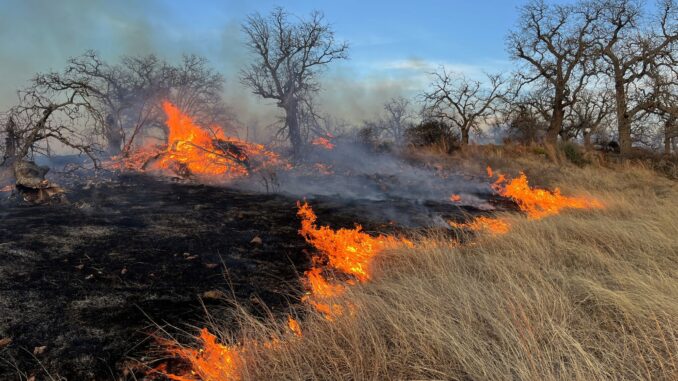
Five wildfires have ignited across Central Texas this week, three of which have already been contained. The Cedar Gulch wildfire in Burnet County burned 237 acres, the Turkey Creek fire in Williamson County scorched 14 acres, and the Old Highway fire in Hays County charred 19 acres.
Two more fires are burning in the Hill Country, where crews continue to work to get them under control.
The Nebo Mountain wildfire started Tuesday afternoon about 14 miles northeast of Fredericksburg.
Local fire departments have been joined by the Texas A&M Forest Service to provide more firefighters and heavy equipment on the ground to battle the blaze.
“The fire area is in very rocky granite covered terrain which limited access and dozer line production,” the Texas A & M Forest Service stated. “Heavily cured grass and mixed brush components contributed to fire behavior that was extreme at times (Tuesday).”
As of Wednesday morning, the fire had burned almost 1,200 acres and was only 40% contained.
This wildfire began earlier this week and is now 90% contained after burning almost 200 acres.
Elevated to near-critical wildfire weather is expected Wednesday across South-Central Texas. A dry line between dry and more humid air masses will shift east during the afternoon, settling near the U.S. 281 corridor. The driest air will be found west of the boundary, where humidity levels could drop to between 10% and 20%, but the winds will be lighter.
East of the dry line, including the Austin area, humidity levels will be slightly higher, at around 30%. However, southerly winds will be breezy at 10 to 20 mph, with gusts of up to 25 mph, maintaining an increased risk of fast-spreading wildfires.
We won’t see much improvement on Thursday because a dry, breezy cold front will move through the region during an especially warm February day with highs well into the 80s.
“The front brings a moderate to breezy northerly flow in its wake with the minimum humidity levels of around 10 to 25 percent,” meteorologists at the National Weather Service wrote in their discussion Wednesday morning. “If confidence increases any more for the areas especially out west, the issuance of a fire weather watch or red flag warning may be needed.”
Leave a Reply