Seasoned photojournalist Ademola Bamigbelu, popularly known as Origa, has built an enduring legacy through his lens, capturing some of the most defining moments in sports—particularly football.
Once a promising footballer, Bamigbelu’s career on the pitch was cut short by a hip fracture. Yet, his passion for the beautiful game never waned. Instead, it found new expression in photography, where his camera became a storytelling tool that chronicles football from an intimate, human perspective.
Football, at its core, is animated by its fans. Their emotions—joy, despair, anticipation, and release—give the game its pulse. Origa does not merely document these moments; he interprets them. His latest exhibition, The Faces of Football, peels back the emotional layers of the sport through the expressions, gestures, and collective energy of its devoted supporters. The conceptual clarity of the exhibition affirms Origa’s mastery of football photography.
Known in sporting circles and among friends as Origa Satiya, Bamigbelu grew up in the ancient city of Ibadan, immersed in football like many children of his generation. His dreams of playing professionally were dashed by injury, but Ibadan itself had already etched its name in Nigerian football history.
READ ALSO: Prison officer who ‘killed’ photojournalist commits suicide in Lokoja hotel
The city produced legends such as Segun Odegbami, MON; the late Mudashiru Lawal, MON; Felix Owolabi, MON; Taiwo Ogunjobi; Sam Ojebode; and Oladimeji Lawal. These icons thrilled millions while starring for clubs like Shooting Stars Sports Club (3SC) and Water Corporation of Ibadan, laying the foundation for Nigeria’s rich footballing legacy and moments of national celebration.
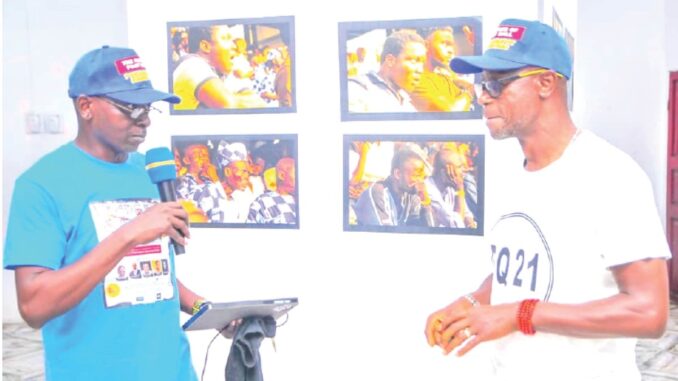
Recently, at the Alliance Française, Iyaganku, Ibadan, the quiet of an empty gallery gradually gave way to laughter, applause, and low conversations. The match on display was not played on grass but mounted on gallery walls. Origa’s The Faces of Football opened to the public, presenting over three decades of Nigerian football through intimate portraits of human expression.
Origa’s work departs from the obvious. While many photographers chase the ball, he follows its emotional aftermath—the furrowed brow of anticipation, a goalkeeper’s private ritual before a penalty, the laughter lines carved by seasons of small triumphs. In this collection, those traces take centre stage. The images do not demand familiarity with names or scores; instead, they invite recognition of feeling.
“The story of every football fan is written on their face,” Origa said during the opening. “It’s joy, disappointment, hope, and unity all in one frame.”
That statement functions as the exhibition’s thesis. Each photograph is less a record of an event than a visual essay on patience, resilience, and communal memory.
The opening programme blended ceremony with conversation, featuring a panel of voices from sports and media. Speakers included Mutiu Adepoju, former Super Eagles midfielder fondly known as “The Headmaster”; Tunde Olawunwo, General Manager of Splash FM 105.5; Tobi Samuel Adepoju, Sporting Director of Shooting Stars SC; and Idris Animasaun, Creative Director of 3SCFAN TV. They reflected on photography’s power to shape football narratives—preserving histories that scorelines and highlight reels often overlooked, from rituals in the stands to subtle coaching gestures and fan folklore.
A recurring theme was the democratic strength of documentary photography. The panelists noted that Bamigbelu’s frames function as communal archives—portable, accessible, and capable of preserving emotional truths beyond statistics.
Mutiu Adepoju emphasised that focusing on supporters, not just players, helps explain football’s deep significance in towns and neighbourhoods where the sport serves as social glue.
Beyond the discussions, the exhibition itself is a lesson in thoughtful design. Large-format prints breathe generously on the walls, while smaller contact prints cluster intimately. The sequencing leads viewers from eruptions of ecstasy to quieter moments of reflection—open-mouthed cheers giving way to exhaustion, prayer, and intense concentration on the faces of coaches.
A section entitled “Metaphysics in Football” revisits Origa’s earlier work on superstition and ritual, reminding audiences that belief—in talismans, chants, spiritual leaders, or coaches—is an inescapable feature of Nigerian football culture.
Workshops and short masterclasses complemented the exhibition, encouraging emerging photographers to look beyond action shots. Origa, whose career bridges journalism and photography, used the occasion not only to reflect but also to mentor—challenging the next generation of storytellers to see football not just as a game but as a living archive of human experience.
WATCH TOP VIDEOS FROM NIGERIAN TRIBUNE TV
Leave a Reply