With freezing temperatures in the rearview mirror, city and community leaders are reassessing how to better protect those living on Austin streets after one person died from apparent exposure to last month’s cold.
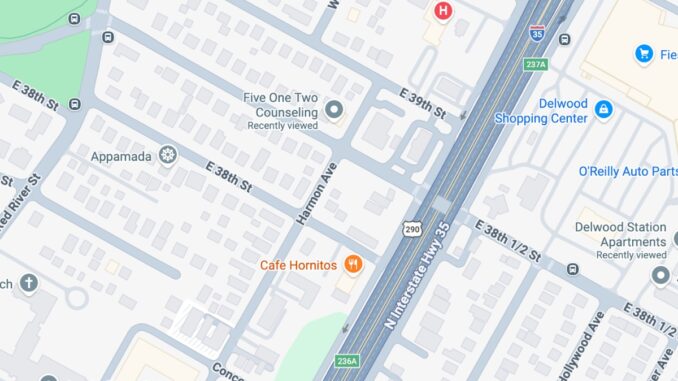
Austin police responded to a report of a man found unresponsive in an abandoned gas station parking lot on the 1000 block of East 38½ Street on Jan. 25. He was pronounced dead at the scene and identified as not having a home to go to. Police said the case remains under investigation and is not being treated as a homicide.
The death occurred during the four-day Winter Storm Fran cold snap that pushed overnight temperatures below freezing, prompting the city to activate six cold-weather shelters across Austin. Before the storm, city officials expanded shelter capacity and coordinated transportation to shelter locations, as outreach groups spread across the city to encourage people living outdoors to seek shelter or accept supplies.

Image credit: Google Maps.
Questions linger about whether those efforts were enough.
The man’s death has raised concerns among service providers and city officials alike about the ability of shelter systems to reach the people most at risk, particularly those living far from centralized intake points or who are reluctant to enter shelters based on past experience or fear.

“Having to maneuver to the One Texas Center, everybody knows that’s the plan, but what do we do when the buses shut down?” asked Sasha Rose, a lead organizer with Austin Mutual Aid. “We call 311 and we wait one to two hours? What does the body do in freezing temperatures in one to two hours? What can happen in that timeframe when people are sitting outside?”
The limitations became more acute amid funding shortages. In November, Austin voters rejected a proposed tax rate increase that city officials said would have supported additional staffing and homelessness resources. Service providers say that loss of funding narrowed the system’s margin for error during emergencies, even as demand continues to grow.
“Law enforcement and first responders are strapped around these times. They’re always responding to car crashes and all these other sorts of medical emergencies that come with bad weather,” said Chase Wright, executive director of the Hungry Hill Foundation.
“Now that we’ve experienced our first emergency situation for our city where you need your local grassroot nonprofits to help you respond because the city isn’t staffed to do so, how does it look as an investment of taking service funds away from the homeless strategy and the homeless service providers?”
The city’s cold-weather shelter system is built around a centralized intake and transportation model that officials say allows for coordination during rapidly changing conditions. For years, One Texas Center downtown has served as the primary registration and embarkation point, where people seeking shelter are matched with available beds and transported to overnight facilities across the city.

Image credit: Cityseeker.com
According to the Homeless Strategy Office, using a single hub allows staff and partner organizations to track shelter capacity in real time, stage vehicles and supplies and adjust operations as shelter locations change from night to night. The city primarily relies on recreation centers for cold-weather shelters, and officials say mechanical issues, staffing constraints or facility limitations can require last-minute changes.
In response to Austin Free Press questions, Housing Strategy representatives also said a centralized system reduces the chance that people are transported to shelters that may already be full or understaffed, particularly during multi-day weather events. Consolidating intake and dispatch in one location is intended to maintain oversight while coordinating across city departments, nonprofit providers and emergency services.
In ideal conditions, the model allows the city to scale shelter operations quickly. During severe weather, however, that system design relies on heavily strained transportation and staffing systems.
For example, that strain was increased when Capital Metro suspended bus service Saturday afternoon because of icy road conditions. For people far from downtown, the shutdown reduced access to the city’s centralized intake point at One Texas Center — particularly people without phones, reliable transportation or familiarity with the shelter system.
Outreach workers and mutual aid groups said the combination of a single embarkation point and reduced transit options created bottlenecks during the coldest hours of the storm. While the city supplemented transportation with city-operated and partner vehicles and directed people to schedule pickups through the 311 hotline, service providers said the reality was wait times of a couple of hours in freezing conditions.
Even when transportation is available, outreach workers note that getting people into shelter is more than a logistical problem because many people living outdoors worry about their personal safety in shelters and fear losing their belongings. Others may avoid centralized intake points due to distrust of institutions or uncertainty about what will happen once they arrive.
Several providers also pointed to the importance of long-term, relationship-based outreach to build trust that can make it possible to overcome reluctance to accept a ride and other assistance.
During emergencies, frontline workers said the consequences of those gaps become more visible, as they scramble to reconnect with people they may not have seen recently.

“A lot of the work that prevents loss of life doesn’t happen during the emergency,” said Matthew Mollica, executive director of the Ending Community Homelessness Coalition. “It happens during the easier times, when outreach teams are building relationships, helping people understand what resources exist and staying connected to folks who may need help later.”
Those challenges are compounded by frequent displacement, as encampment removals and changing living patterns can break established connections with people living outdoors, providers told Austin Free Press. Those with experience building relationships with the unhoused said the success of cold-weather response depends on systems that can support ongoing engagement.

Nyeka Arnold, executive director of the Healing Project, said outreach groups often find themselves filling gaps during emergencies, with limited resources and little margin for delay. While she credited city staff for expanding shelter capacity during the recent storm, she said the response highlighted how much the system depends on small, community-based organizations that operate year-round.
“I feel like the city has done what it has the capacity to do,” Arnold said. “But if they supported the organizations that are already out there doing this work, we’d be able to fill more of those gaps.”
Arnold said her organization and others spent the cold snap conducting wellness checks, distributing supplies and transporting people who were reluctant or unable to navigate centralized intake systems. In some cases, she said, repeated visits and familiar faces made the difference between someone accepting shelter or remaining outside.
City officials have acknowledged the need for sustained investment in regional outreach and stronger coordination with community partners. In written responses to Austin Free Press, the Homeless Strategy Office said it is exploring improved data sharing, more consistent funding streams and closer collaboration with organizations that maintain long-term presence in specific areas of the city.
All agree that preventing further loss of life in extreme circumstances requires stable funding beyond emergency activations. While the city has expanded shelter capacity and coordination in recent years, providers said the response to last weekend’s storm illustrates how dependent those efforts remain on staffing levels, transportation availability and the day-to-day work of outreach organizations.
For those working on the front lines, the fatality during the January storm underscores both progress and fragility in Austin’s homelessness response system.
“A lot of the time, when there’s a loss of life, it’s because someone was already dealing with serious health issues and couldn’t determine what was safe for them,” said Wright of the Hungry Hill Foundation. “That’s why the everyday outreach, knowing who people are and where they are matters long before bad weather hits.”
Chad Swiatecki is a 30-year journalist who relocated to Austin from his home state of Michigan in 2008. He most enjoys covering the intersection of arts, business and local/state politics. He has written for Rolling Stone, Spin, New York Daily News, Texas Monthly, Austin Monitor, Austin Business Journal, Austin American-Statesman and many other regional and national outlets.
Leave a Reply