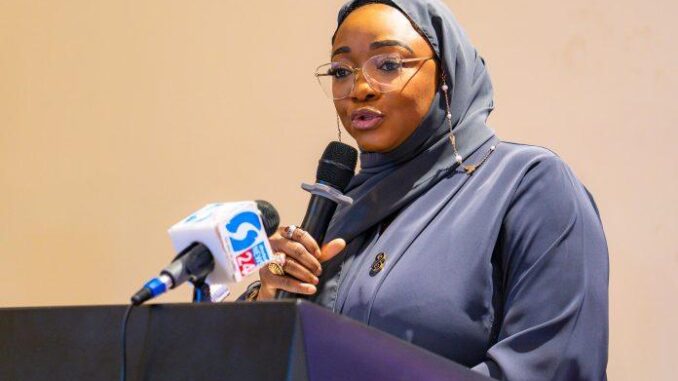
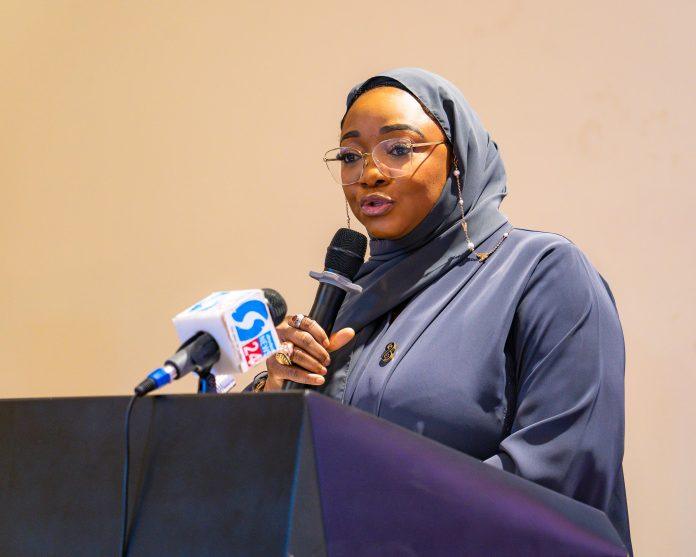
The Minister of Women Affairs and Social Development Hajiya Imaan Sulaiman-Ibrahim has called for a deliberate, inclusive, and policy-driven transformation of the country’s agri-food system.
Speaking at the launch of the CGIAR Policy Innovation Hub in Nigeria and a High-Level Policy Dialogue organised by the International Institute of Tropical Agriculture (IITA) in Abuja, the Minister stressed that the future of agriculture depends on placing women at the centre of national development efforts, coordinated policy, partnerships, and measurable grassroots impact.
“This gathering is not just another policy event. It is an important opportunity to reflect on the kind of food system Nigeria must build if we are to achieve inclusive growth, sustainable livelihoods, food security, resilience, and shared prosperity,” she said.
She warned against disjointed efforts, noting that “Nigeria’s agricultural future cannot be secured through fragmented action,” and emphasised the need for an integrated, systemic approach.
READ ALSO:EU Backs €85m EIB–BOI Deal for Nigeria’s Agriculture
Highlighting gender inclusion as critical, the Minister declared, “Nigeria cannot fully transform its agri-food system without transforming the role of women within that system.”
She described women as “indispensable actors in agriculture and food systems,” while pointing to structural barriers limiting their productivity. “This is not only a gender gap. It is an economic inefficiency. It is a development gap. And it is a national opportunity gap,” she stated.
The Minister called for intentional gender inclusion. “Gender inclusion must be intentional, not symbolic. Women must be integrated into agricultural transformation from the design stage,” she said, stressing access to land, finance, and technology.
The Minister urged a shift beyond primary production. “We must move beyond production-only thinking,” she said, advocating value addition across processing, packaging, storage, transport, and exports.
Further emphasising collaboration, she stated, “Partnership must become operational. Government cannot do it alone. Researchers cannot do it alone. The private sector cannot do it alone”.
Framing women’s empowerment as an economic strategy, she said, “When women earn more, families are stronger, food security improves, community welfare rises, and local economies expand”.
On accountability, she posited, “We must increasingly judge interventions not only by activity reports, but by what changes in real lives: incomes improved, enterprises built, markets reached, productivity increased, and resilience strengthened.”
 However, reinforcing thorough implementation, she cautioned: “If policy does not reach the farm, the processor, the trader, the cooperative, the young entrepreneur, and the rural woman, then policy has not yet achieved its full purpose.”
Sulaiman-Ibrahim reaffirmed her Ministry’s commitment to initiatives such as Women Agro Value Expansion (WAVE), noting that “True empowerment must go beyond subsistence support and create pathways for women to participate meaningfully in the full chain of value creation.”
The Minister ended with a call to action: “We must build a food system that is productive, inclusive, resilient, evidence-driven, investment-ready, and women-responsive.”
Leave a Reply