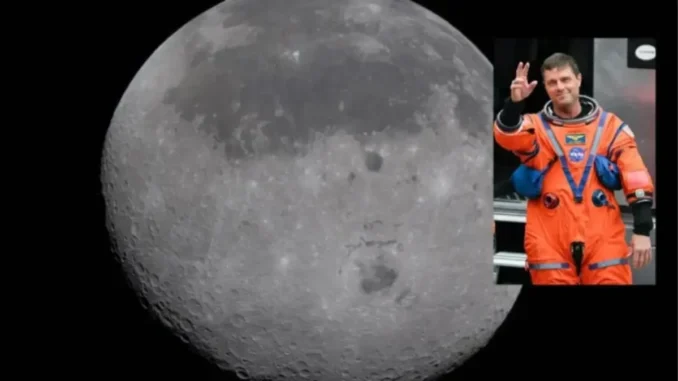
Astronauts aboard Artemis II have named a lunar crater in honour of the late wife of mission commander Reid Wiseman, in an emotional moment during their historic journey at the outer edge of human spaceflight.
The tribute was announced on Monday as the crew orbited near the Moon, with Canadian astronaut Jeremy Hansen revealing the name during a live broadcast.
“It’s a bright spot on the moon. And we would like to call it Carroll,” Hansen said.
He added that the crater can be seen “at certain times of the moon’s transit around Earth.”
The naming honours Carroll Taylor Wiseman, who died in 2020 after a battle with cancer. As the announcement was made, Wiseman and his fellow crew members were visibly emotional, sharing a silent embrace inside the Orion spacecraft.
The crew also named another nearby crater “Integrity,” after their spacecraft.
“Her name was Carroll, the spouse of Reid, the mother of Katie and Ellie (daughters of Reid and Carroll),” Hansen said.
“A number of years ago, we started this journey, and we lost a loved one, and there’s a feature on a really neat place on the moon. At certain times of the Moon’s transit, we will be able to see this from Earth,” he added.
Mission Control later confirmed the proposed names, though final approval rests with the International Astronomical Union.
The moment came as the four-member crew became the humans to travel farthest from Earth, surpassing previous records set during the Apollo 8 mission. Astronaut Jim Lovell had similarly named a lunar crater after his wife during that earlier flight.
During the flyby, the Orion spacecraft is expected to pass as close as 4,070 miles above the lunar surface, allowing the crew to observe previously unseen regions with the naked eye.
The mission includes a seven-hour observation phase, during which astronauts will study about 30 scientific targets, including craters, ancient lava flows, and surface fractures near the Orientale basin.
The newly named “Integrity” crater lies just northwest of the basin, while “Carroll” is located to the northeast, near the boundary between the Moon’s near and far sides, and may be visible from Earth at certain times due to its position.
WATCH TOP VIDEOS FROM NIGERIAN TRIBUNE TV
Leave a Reply