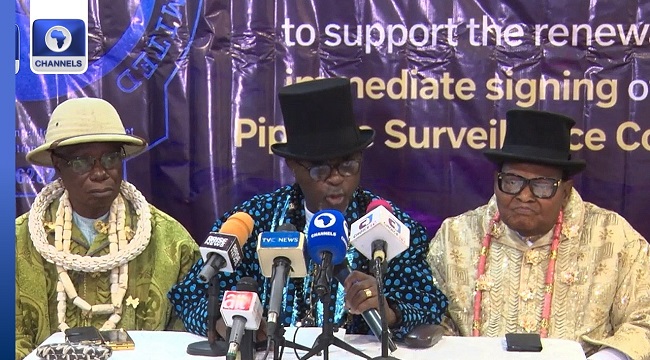
Traditional rulers in Rivers State have thrown their weight behind the current pipeline surveillance structure in the Niger Delta, urging the Federal Government to resist calls for its decentralisation amid growing debate over the future of oil asset protection in the region.
The monarchs made their position known during an expanded press briefing in Port Harcourt on Saturday, where they reviewed the performance of the pipeline surveillance contract introduced in 2022 to combat crude oil theft and vandalism.
Support for Status Quo
At the heart of the discussion is the surveillance framework currently handled by Tantita Security Services Nigeria Limited, which stakeholders say has significantly improved security across oil-bearing communities.
The traditional rulers expressed satisfaction with the arrangement, noting that it has brought relative peace and stability to their domains.
READ ALSO: Niger Delta: CSOs Reject Calls To Revoke Pipeline Surveillance Contracts
The Traditional Ruler of Abuloma, HRM Bright Fiboinumama, backed Tantita Security Services, saying, “As traditional rulers and chiefs of our various kingdoms in Rivers state, we vehemently oppose the decentralization of the pipeline surveillance contract currently being handled by Tantita Security Services Limited. This is to avoid disorganization of the security situation being enjoyed by our individual communities.
Speaking further, he said, “We thank the President and Commander in Chief if the Armed Forces, His Excellency Bola Ahmed Tinubu for finding our son, High Chief Government Oweizide Ekpemupolo aka Tompolo worthy of carrying out this noble and lofty assignment which has made us proud”
Also lending his voice, the Amanyanabo of Kula Kingdom, Kroma Eleki-Sara XIV, emphasised that their communities are already benefiting from the current system.
“I align with every other person here to appeal to Mr President to continue to give this contract to Tantita Security Services limited. We’re having very good water now, there’s no bunkering again, our people are now able to catch fish in their normal usual traditional way”
They warned that any attempt to fragment the contract could undermine the gains recorded so far.
Debate Over Decentralisation
Calls to decentralise the pipeline surveillance contract have been gaining traction among some stakeholders, who argue that expanding participation would promote inclusivity and create more opportunities across the region.
However, the monarchs strongly disagree.
They argued that splitting the contract among multiple operators could weaken coordination, reduce efficiency, and potentially trigger a relapse into the era of rampant oil theft and environmental degradation.
The Amanyanabo of Bukuma, Stephen Tobins, echoed similar concerns, stressing that consistency and structure have been key to the progress recorded.
Call for strengthening
Rather than decentralisation, the monarchs are advocating for the strengthening of the existing framework.
They are calling on the Federal Government to consolidate the current system, improve oversight, and sustain collaboration with host communities to ensure continued protection of critical oil infrastructure.
According to them, maintaining a unified structure will better safeguard oil production levels, support environmental protection, and preserve stability in the Niger Delta.
What lies ahead
As the debate continues, the decision now rests with the Federal Government — whether to maintain a centralised model that stakeholders say is delivering results, or to adopt a decentralised approach aimed at broader participation.
For now, traditional rulers in Rivers State are making their position clear: when it comes to pipeline security, they believe continuity may be the key to sustaining progress.
Leave a Reply