I am a proud advocate of democracy, both generally and in its specifics. I promote the components that make democracy real — free and fair elections, an expansive franchise, the rule of law and freedom of speech, to cite but a few.
Although I am an emeritus professor now, for years in my course on voter suppression I taught the benefits of democracy and the harm that autocracies wrought. We studied the rise and fall of voter suppression techniques across American history, their increasing use in recent years and how they have undermined vigorous multiracial democracy.
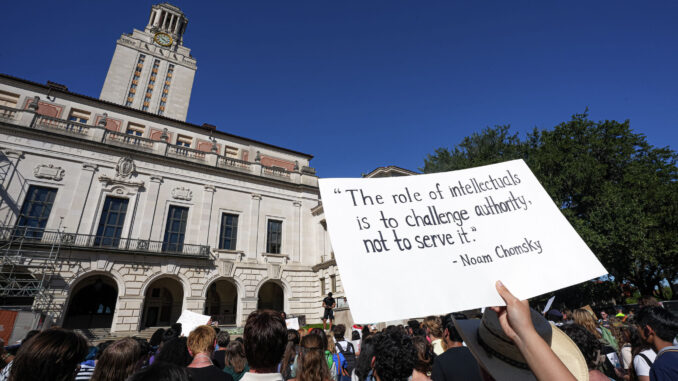
Yet today the course would risk running afoul of the University of Texas Regents’ vague rules against teaching controversial material and advocating for particular points of view. Indeed, advocating for democracy now appears to be “controversial,” since the Board of Regents’ rules are themselves undemocratic because they violate the First Amendment. In any case, I would not be willing to provide an alternate defense of autocracies that seems to be required by the rules.
Perhaps the rules are intended to be more specific. What would be more controversial than teaching about institutional racism? American history since the Civil War provides numerous examples of states using institutions, especially government, to deny Blacks their constitutional right to vote. The trick was to suppress votes without explicit violation of the 15th Amendment.
One of those techniques was the White Primary, employed by Texas and most other Southern states during the Jim Crow era. Political parties, categorized by the states as private organizations, were empowered by law to limit primary elections to whites. But the Southern states were one-party bastions; the winner of the white-only Democratic primary won the election. The Supreme Court struck down this abomination as unconstitutional in 1944.
Surely this is racism. Just as surely institutions — government and parties — did the dirty deed. Could I teach this example of institutional racism today, under the Regents’ rules? Yes or no, UT administration? If yes, then would I be empowered to teach the whole sordid history of Jim Crow denials of voting rights? That Texas was not a democracy during this period? That the voter suppression techniques developed in the 1890s are repeated today? Could we discuss whether this continues to be institutional racism?
I was a freshman at the University of Alabama when Gov. George Wallace made his infamous “stand in the schoolhouse door.” Yet in that period of intense controversy over segregation, we learned from our professors that Alabama was not a democracy; that most of Southern politics revolved around the denial of Blacks the right to vote; and that the deep Southern states were governed by a cabal of conservative planters and industrialists. My professors showed how Southern state autocracies had fallen behind Northern state democracies and advocated two-party democracies as antidotes.
I recall no censorship on the level of what is happening at the University of Texas today. The University of Alabama at the time desperately wanted to be a recognized university, and censorship of courses could have led to decertification. Today, by prohibiting the teaching of arbitrarily determined controversies, the University of Texas signals that it lacks the will to be better.
It is clear that the Regents’ objective is to smother free speech on campus. So I have one request of them. Please plaster over the biblical statement so prominently displayed on the tower: “Ye shall know the truth and the truth shall set you free.”
The plaster can be removed when this once-great university rediscovers its prime purpose, expressed in its seal: disciplina praesidium civitatis — “The cultivated mind is the guardian genius of democracy.”
Bryan Jones is the J.J. “Jake” Pickle Regents’ Chair in Congressional Studies, Emeritus.
Leave a Reply